

Table of Contents
A good political campaign is the single most influential factor in determining which party or candidate wins an election. Political campaigning entails:
- Reaching out to your voters.
- Letting them know who you are.
- Telling them what you stand for.
- Educating them about why they should vote for you.
In today’s world, there are many methods campaigns use to attract your attention. The traditional way is through broadcast media like radio, TV, or simply newspapers. The more modern way, and the one that is gaining a lot of traction, is through social media, email, and online advertising.
Read Also: Get out the Vote: Research-backed Strategies and Tools to increase Voter Turnout
However, campaigning works most effectively when it has a personal touch. After all, a voter might be more influenced to support a campaign through a volunteer than a poster outside a store, right? Door-to-door canvassing allows voters to hear you, and you learn more about voters. Unfortunately, for larger campaigns or those with a time restriction, it just isn’t possible to visit every voter to campaign. Besides, without a large pool of volunteers, door-to-door canvassing is almost impossible.
This is where phone banking comes in. Political phone banking is a process in a political campaign to reach out to voters via phone calls to canvass or get out the vote. Campaign teams often carry out phone banking using call center software, commercial phone banks, or volunteer-run phone banks.
Through phone banking, you can reach thousands of voters quickly and efficiently. How long does it take to call a single voter? Just 3 minutes, sometimes even less, depending on the campaign type, list quality, and calling setup.
Just imagine: if you have four or five volunteers calling voters, you can reach a large number of voters in a very short time. And if canvassing is combined with phone banking, the two can be extremely effective at improving voter turnout and increasing support. Talk about killing two birds with one stone! Read more about how you can combine door-to-door canvassing and phone banking.
Read Also: Complete guide to political phone banking
Key Takeaways
Political phone banking lets campaigns reach voters by phone at scale, and modern software-based tools make it far faster and more personal than traditional calling methods.
Why Phone Banking Matters
- Personal outreach through volunteers and door-to-door canvassing influences voters more than posters or broadcast ads, but canvassing alone can’t scale without large volunteer pools or enough time.
- A single voter call takes about 3 minutes or less depending on campaign type, list quality, and calling setup, letting a handful of volunteers reach many voters quickly.
- Combining door-to-door canvassing with phone banking is especially effective for boosting voter turnout and support.
Traditional vs. Software-Based Phone Banking
- Traditional phone banking requires volunteers to manually dial numbers, record call information on paper, and have someone separately enter survey data into a CRM, making it tedious and expensive at scale.
- Software-based phone banking lets volunteers log in via browser while the system assigns voters to agents, displays accurate voter information, and stores call feedback automatically.
- Automated dialing that skips bad numbers, answering machines, and busy signals cuts call time by 50% compared to the traditional method.
- Virtual phone banking allows volunteers to call from home, follow an in-browser script, and record outcomes directly into the campaign database instead of using paper lists or spreadsheets.
Common Use Cases
- Voter identification calls determine whether a voter supports, opposes, or is undecided, helping campaigns focus future outreach on the right audience.
- Get out the vote calls remind confirmed supporters to vote and help them confirm polling locations or make a vote plan.
- Persuasion calls target undecided voters and require trained volunteers and stronger scripts for real conversations.
- Other uses include fundraising calls to existing or warm donors, volunteer recruitment among supporters, and ballot chasing to follow up with voters who requested but haven’t returned mail-in ballots.
How does phonebanking work?
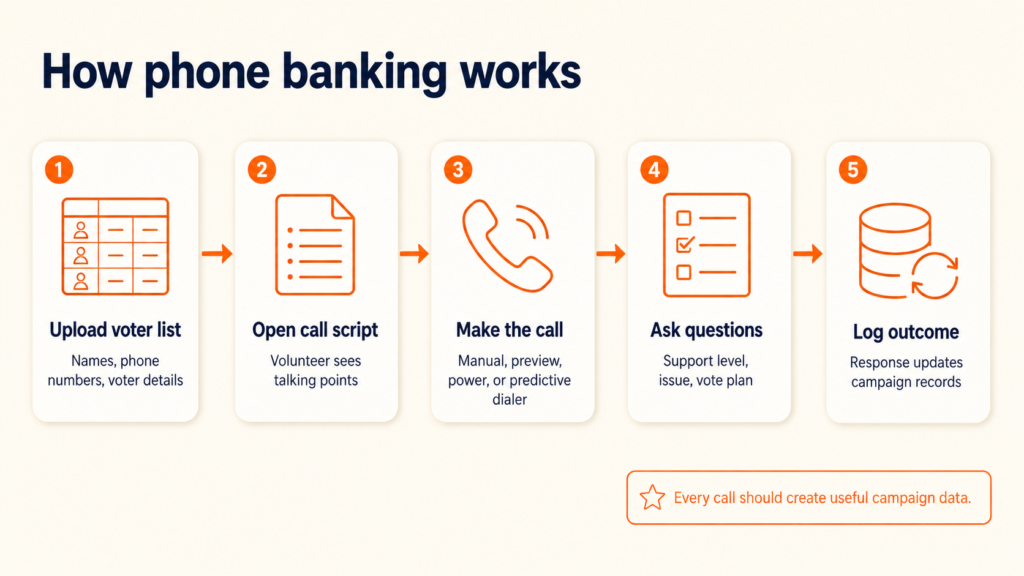
Now that we know what phone banking is, the next question is, how exactly does it work?
Well, phone banking basically involves volunteers calling voter lists and talking to them about the campaign. These campaigns can be of different sorts: some might be for getting out the vote (GOTV), some might be for recruiting volunteers, while others might be for raising funds or identifying voters.
Case Study: How Organizing for Change ran a successful GOTV campaign with phone banks
Some campaigns use traditional phone lines to call voters. Each volunteer has to manually dial a number, wait for the caller to pick up, and then talk to them. They must record the call information on paper, and someone manually enters the survey data into the CRM. Boring and tedious, much? You bet! When you have thousands of voters to reach out to, traditional phone banking becomes monotonous, inefficient, and expensive in time and money.
Advanced phone banking tools are software-based. Here, volunteers can simply log in to the system on their computers and make calls via a browser if needed. The system handles assigning voters to agents, displaying accurate voter information, and storing all call feedback.
So how does it help save time? Simply put: by calling the number for you and skipping bad numbers, answering machines, and busy numbers.
Each call made by a volunteer now takes 50% lesser time than the traditional method.
Virtual phone banking is now common, too. Volunteers can call from home, follow the script in the browser, and record call outcomes directly in the campaign database instead of working from paper lists or separate spreadsheets.
What is phone banking used for?
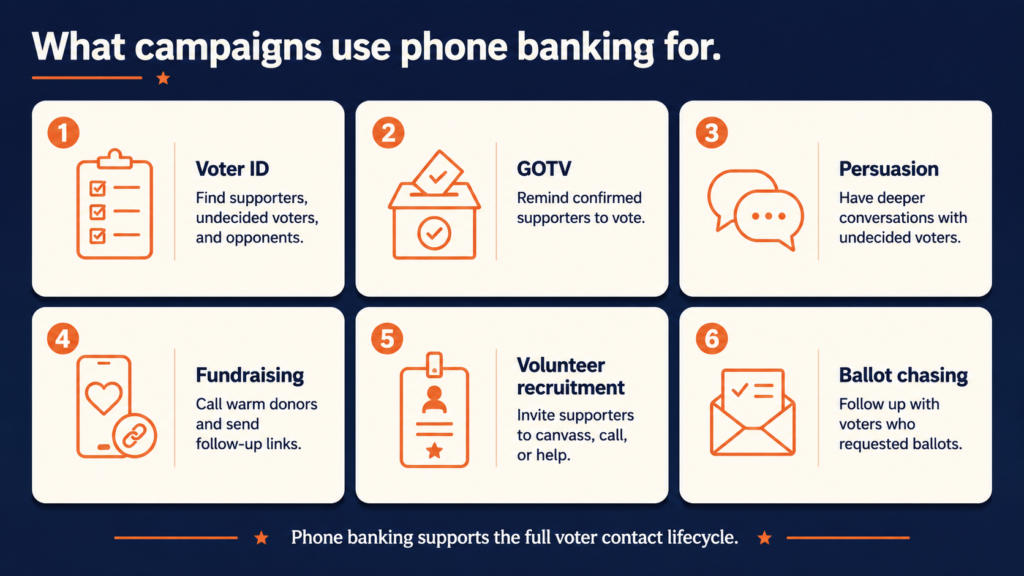
Phone banking shows up anywhere an organization needs to reach a large group of people quickly and personally. Political campaigns use it to identify supporters, persuade undecided voters, and drive turnout on election day. Advocacy groups use it to mobilize members around a bill or a cause. Nonprofits use it for donor outreach and event recruitment. Unions use it to reach members during organizing drives and contract campaigns. The mechanics stay the same across all of these – a script, a call list, and volunteers or staff working through it together – only the goal changes.
| Running a campaign specifically? Read our Political Phone Banking Guide for Campaigns |
Common political phone banking use cases include:
- Voter identification
Campaigns call voters to find out whether they support, oppose, or are undecided about the candidate. This helps the campaign stop wasting time on the wrong universe and focus future outreach. - Get out the vote
In get out the vote campaigns, volunteers call confirmed supporters to remind them to vote, confirm polling place details, or help them make a vote plan. - Persuasion calls
Persuasion calls are for undecided voters. These calls need trained volunteers, stronger scripts, and enough time for a real conversation. - Fundraising calls
Campaigns use calls to reach existing donors, warm supporters, or people who have already shown interest. A live call can create the ask, and a follow-up text or email can send the donation link. - Volunteer recruitment
A phone bank can also help with recruiting volunteers. Supporters who already like the campaign may be willing to canvass, call, text, host an event, or help on election day. - Ballot chasing
Campaigns call voters who requested mail-in ballots but have not returned them yet. These calls are most useful when paired with updated ballot status data.
For a broader breakdown of campaign calling strategy, use this political phone banking guide.
How to set up a phone bank
Phone banking is extremely easy to set up if you have a phone banking software like CallHub. However, there are a few things you need planned for your campaign, such as:
List of voters to be called
The script that volunteers need to follow when talking to voters
Recruit a list of volunteers who can phone bank for you
Survey questions to be answered, if any.
Train your volunteers on what to talk about and what feedback to store. Read more about How to train your campaign volunteers.
10 tips on how to run a successful phone bank
Host a phone banking event
A phone banking event brings volunteers together, in person or remotely, to make calls as a group instead of individually. It works because people show up and stay longer when they’re calling alongside others, and a shared room (or shared call) makes it easier to troubleshoot scripts, swap tips between calls, and keep energy up during a long shift.
Here’s what goes into planning one:
Pick a format. In-person events work well when you have a shared space – an office, a campaign headquarters, a volunteer’s living room – and want the energy of a room full of callers. Remote phone banks work via video call or a shared dialer link and let you bring in volunteers who can’t travel. Most campaigns run both, depending on the week.
Set a time block. Two-hour shifts are the standard – long enough to get through a meaningful number of calls, short enough that volunteers don’t burn out. If you’re running a GOTV push close to election day, stacking two or three back-to-back shifts in a single evening works better than one long session.
Assign roles before anyone dials. A shift lead who opens the session, walks through the script, and answers questions as they come up. A data lead who manages the call list and logs results. Everyone else calls. For larger events, add a tech lead if you’re troubleshooting a dialer or video platform.
Prep the room (or the call). Send the script and call list ahead of time. Have a run-through or a quick role-play before the first real call, especially if you have new volunteers. For in-person events, printed scripts and a shared results tracker on a whiteboard keep things moving without everyone having to hunt for their laptop.
Debrief at the end. A five-minute wrap-up highlights what worked, what didn’t, and the script’s effectiveness, and shows volunteers that we value their time and feedback.
Different kinds of phone banking
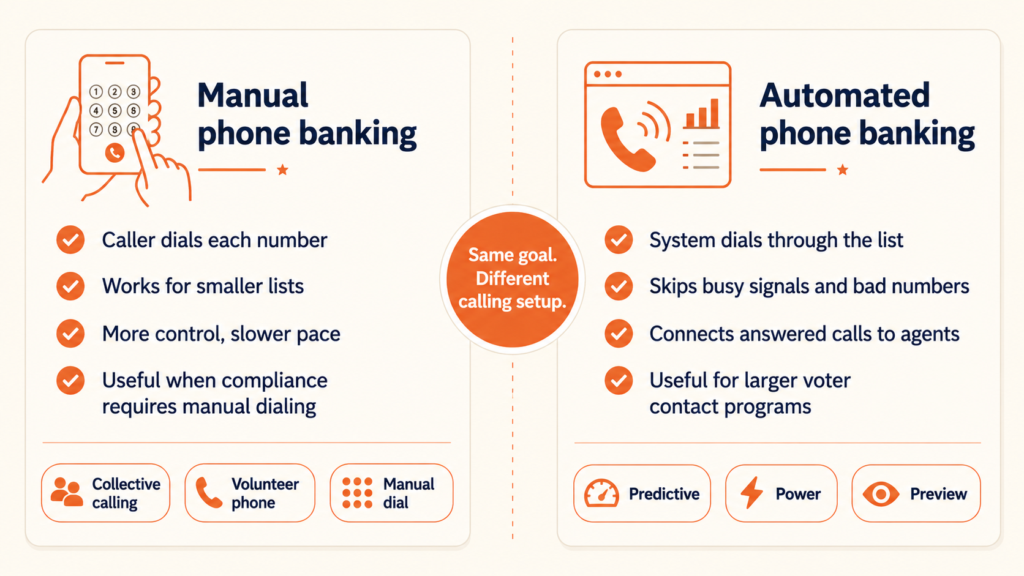
You can choose two types of phone banking: automated and manual. Let’s understand how the two of them work, shall we?
1. Automated
The automated dialer dials through a contact list, and when a call is answered, it connects the caller to a live agent. This type of system is called a virtual outbound call center.
Relax, it’s not as complicated as it sounds. See how CallHub’s auto dialer works and how simple it is to set up.
So the next question is… how do agents connect to the software offered by CallHub? Well, there are two ways for this to happen:
Using a browser
The agent only needs a computer and a headset to be good to go. As simple as that! The agent would need to use the CallHub browser interface to read the provided script and complete the surveys.
Using a browser offers advantages: it is affordable, requires only a single device, and is hands-free.
Using a phone
Here, the agent uses a phone to connect to the campaign. The agent opens the CallHub application in a browser on a computer to read the script and answer surveys.
There are two modes: either the agent dials into the campaign, or the agent receives a call to be connected. How are the modes chosen? They are based on the phone plans in your country and the respective pricing.
The advantage of using a phone is that it is more convenient for older volunteers, and you do not require a high-speed internet connection to make your calls. On the flip side, it is a tad more expensive and requires more than one device.
In automated phone banking, there are three types of dialers that users can employ according to their needs:
1. Predictive dialer
A predictive dialer is extremely useful if you want to reach out to as many people as possible. This is necessary for large campaigns such as voter identification. The dialer calls a contact list and only routes answered calls to the agents.
This helps save a massive amount of time, as dial tones, unanswered calls, answering machines, etc get weeded out. So agents are focused only on talking to supporters, rather than listening to an unending dial tone or a robotic answering machine.
2. Power dialer
The power dialer dials the numbers automatically while the caller focuses on the live call at hand. It is a less rushed form of calling where the agent has time to fill up the survey, enter notes, and then begin the next call.
You can also set a dial rate, which helps speed up the campaign while giving volunteers adequate time to fill out survey questions.
3. Preview dialer
The preview dialer is a flexible type of dialer in which an agent needs time to research the contact. The conversations are generally more in-depth and could be follow-ups to previous conversations.
The manager still has control over the people being called and gets a detailed recording of each call.
2. Manual
Also known as collective calling, manual calling has the same interface as the automated dialer. So what’s the difference? Well, the calls, in this case, are not made by CallHub; the agent would have to manually dial in the number on a phone, then use CallHub to go through the script and answer survey questions.
So why use collective calling over dialing a number yourself, or with a group of volunteers?
This might work if all the agents are in the same place, but if everyone is spread geographically, coordinating with each other will be a major hassle.
What collective calling does is make the calling process seamless and dynamic: based on the number of active agents at a particular time, contacts are assigned to them.
This ensures that all contacts are called and no one is missed. Besides, using CallHub’s software, it is possible to remove agents who aren’t doing too well.
So what should you use, an automated or manual dialer?
You can use Automated Calling if
You are a political campaign looking to reach voters
An advocacy group
You are not bound by any TCPA regulations
And similarly, you can use Collective Calling if
You are restricted by TCPA regulations but still would like to optimize your campaign
Most of your contacts are mobile numbers, not landline numbers; you’d prefer dialing them rather than calling using an automated dialer…again due to TCPA regulations
For campaigns comparing dialer options, start with the overall phone banking software setup and then choose the dialer mode based on your list, compliance needs, and volunteer capacity.
Is phone banking effective?
Phone banking is effective when it is done well. Live, genuine conversations from trained volunteers can move voter behavior in ways robocalls and generic digital ads often do not.
StatesWin’s 2022 Phonebanking Research summarizes evidence that quality calls from trained callers can produce a 3–5% boost in voter turnout. The same research notes that volume-focused calling from poorly trained callers may produce only about a 0.5% boost.
That gap is the main lesson. The quality of the call matters more than the raw number of dials.
Phone banking also has limits. Many voters screen unknown numbers. Spam labels can lower pickup rates. Heavy-contact periods can create call fatigue. A cold list with a weak script will not perform as well as a warm supporter list with trained volunteers.
Phone banking works best when campaigns use it for the right job:
- Calling identified supporters close to election day
- Following up with voters who already engaged by text or email
- Persuading undecided voters with trained callers
- Confirming vote plans
- Reaching donors or volunteer prospects who already know the campaign
Door-to-door canvassing remains one of the strongest voter contact methods. A J-PAL summary of Gerber and Green’s New Haven field experiment found that personal canvassing increased turnout by 8.7 percentage points. But canvassing takes more time per contact, while phone banking lets campaigns reach more voters in less time.
For a deeper breakdown, see our full article on whether phone banking is effective.
If you’re ready to go further, the complete guide to political phone banking covers strategy, scripts, volunteer management, and running your first campaign end-to-end.
Phone banking vs. canvassing: when to use each
Phone banking and canvassing are not replacements for each other. They are stronger when campaigns use them together.
Canvassing is better for high-value persuasion and dense neighborhoods. Phone banking is better for scale, follow-up, GOTV, and large voter lists.
| Factor | Phone banking | Door-to-door canvassing |
| Reach per hour | Up to 110 contacts with an autodialer, depending on list quality and pickup rates | Up to 20 doors, depending on geography and turf density |
| Cost per contact | Low, mostly software and volunteer time | Higher, with transport, materials, and volunteer travel time |
| Best for | GOTV, warm contacts, ballot chasing, large voter lists | Persuasion, dense precincts, high-value undecided voters |
| Effectiveness | 3–5% turnout boost from quality calls | Up to 8.7 percentage point turnout lift from personal contact in the Gerber and Green study |
| Limitations | Low answer rates, spam filters, call fatigue | Weather, geography, safety, volunteer bandwidth |
| Works best when | Combined with prior voter ID work | Targeted to specific precincts or demographics |
The practical answer is simple: use canvassing when the conversation needs to be personal and place-based. Use phone banking when the campaign needs reach, speed, follow-up, or a final push for turnout.
Frequently asked questions about phone banking
What is a phone bank?
A phone bank is the setup, system, or group of people used to make outreach calls. Phone banking is the act of making those calls.
What is the difference between phone banking and robocalling?
Phone banking usually involves live conversations between real volunteers or agents and voters. Robocalls are prerecorded automated messages, and the StatesWin 2022 phone banking research notes that robocalls have generally shown little to no turnout effect compared with live calls.
Can you do phone banking from home?
Yes. Virtual phone banking lets volunteers call from home using phone banking software. They can view the script, call list, and survey questions in the browser while the campaign centrally tracks responses.
What do phone bankers do?
Phone bankers follow a phone banking script to have structured conversations with voters. They may identify support levels, share candidate information, remind people to vote, recruit volunteers, request donations, or record survey responses.
How long does a phone banking shift last?
Most campaigns run two- to three-hour phone banking shifts. That is usually long enough to make meaningful progress without exhausting volunteers.
What is the best time to call voters?
Most campaigns test evening calling windows because voters are more likely to be available after work. A common starting window is 5 p.m. to 9 p.m. local time, but campaigns should track their own answer rates by list and region.
Is phone banking legal?
Yes, but campaigns need to follow compliance rules. The FCC’s TCPA guidance explains rules around autodialed calls, prerecorded messages, and mobile numbers. Always confirm the rules for your campaign type, dialing method, and jurisdiction before starting.
What is phone banking in politics specifically?
In politics, phone banking is the organized practice of calling voters to identify supporters, turn out the vote, persuade undecided voters, recruit volunteers, or raise campaign funds. It remains useful because it provides campaigns with a direct channel for conversation, especially when combined with canvassing, texting, and email.
What does it mean to phone bank?
To phone bank means to call a list of people – usually voters, supporters, or members – on behalf of a campaign or organization, following a script to have the same conversation at scale. It’s the phone-based counterpart to door-to-door canvassing.
What does phone bank mean?
A phone bank is either the group of people making those calls or the event where they gather to do it. The term covers both the activity (“we’re phone banking tonight”) and the setup itself (a room, or a shared virtual space, where volunteers call from a list together).
What’s next?
If you want a deeper look at how all of this fits together operationally, the complete guide to political phone banking walks through strategy, setup, and execution in one place. You can also explore CallHub’s phone banking software to see how campaigns set up calling lists, scripts, survey questions, volunteer access, and live reporting in one place.
Featured Image Source: Olha Ruskykh